Note; there are many high resolution photos on this page ; please be patient while they load. Thanks!
Winter Flying Sites, Ski Equipped Aircraft, and SPARCS Winter Flying Events
Winter arrives early and stays late up here, but that hardly keeps us from flying!

A few of the flyers at the SPARCS 13th Annual Winter Fly-In, February 2003 at Lost Creek; great flying site!

Herk Almgren ready to start his Seamaster for a flight at Lost Creek RC Airpark.
For many years, the SPARCS Winter Fly-In was held on Lake Dillon. But times change... In the early winter of 2002-2003, 'Kite Boarding' is a new activity that has 'found' this area of Lake Dillon. Since this area is a 'multiple use recreational area', all individuals have equal rights to use the snow & air. The kite boarders can't do too much until the winds come up to a strength where most RC flyers are packing away their airplanes, but they will walk out & set up their kites, waiting for the winds to come up. Their activity & use of the area, unfortunately, leaves substantial (deep) tracks crossing the prevailing wind direction- crossing the direction that RC planes on skis normally attempt to take off and land. The result is that we no longer have the ideal snow conditions that we have enjoyed using at this site since 1991, and we now have other people who have found another use for the area that we fly over. In 2004, there's plenty of kite boarding activity.
SPARCS hosts a Winter Fun-Fly-In each winter. The 16th annual SPARCS Winter Fly-In will be held on Sunday, Sunday, January 22nd, 2006. This year, the event is being held at Teke's "Lost Creek RC Airpark", which is located north of Silverthorne on Co. Hwy, 9 about 14 miles, where you turn to the right and follow the signs for about 2 miles. (Note that Lindstrom Road is closed in the winter; Follow Elk Run road & the signs to the Flying Site.) Flying starts by 9AM, and continues until 3PM. Food and beverages will again be available, as usual.
Here's the map of the area.

Wear your good snow boots, and join us for a great day of winter flying!
Contact Ron Teke, CD & Site Owner 970 390-1826 Cell, or the event CD, Bruce Stenulson, for further details by phone at 719-836-2489, or by E-mail to stenulson@amigo.net

The core of "Team Teke", Ron & his son Chris, prep a giant scale Beaver for flight
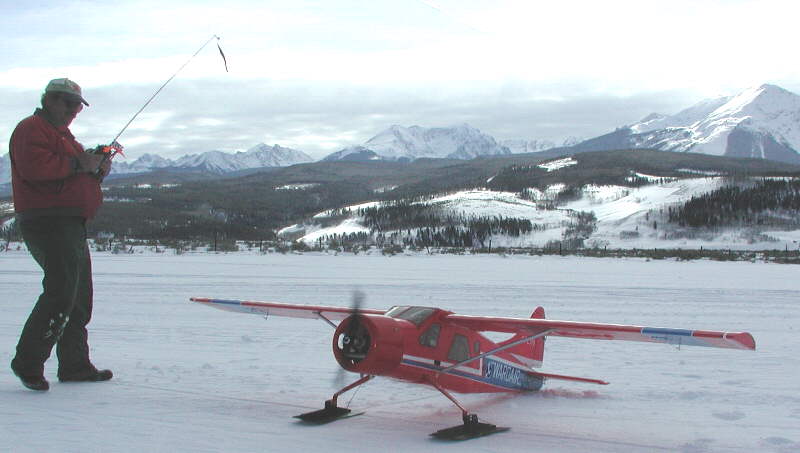
Here's the giant Beaver taxiing back in after a great flight.

Above: SPARCS Charter member Peer Bjornstad holding a reduced scale WILD HARE which he built for E-power; nice flyer!!

Above is SPARCS member Ken Kirsch with his LT-40 on skis. When set up as a taildragger, the LT40 makes a great ski plane. As you can see, Ken did a great job building and finishing this aircraft!

Above is a photo of the "SHORT HARE" on skiis; it's about as short-coupled as they get, and flat spins very nicely.
Visualize a runway that's 3/4 of a mile wide, and several miles long; many frozen lakes provide these ideal winter flying conditions.

Lake Dillon, Colorado, at Farmer's Korner on the South end of the lake [FK], is one such local site, at an elevation of about 9000 feet. Once the lake freezes solidly in mid-December, and the snow covers the ice, SPARCS members sometimes gathered there on some late afternoons and almost every Saturday and Sunday (when conditions permit) to fly! With the boom in kite boarding activity since the winter of 2002-2003, snow conditions are not often as suitable as they were in the 'good old days' prior to their discovery / heavy use of this site.
There are two other areas on Lake Dillon where we have flown over the years. The first and more usable is Giberson Bay [G], which requires walking in from the parking area a couple of hundred yards to fly over the snow covered ice of Lake Dillon. (If winds pick up more from the NW, blowing from the parking lot towards this section of the lake, then some rotors can be generated by the trees along the shoreline. If winds are coming more out of the west, this is not a problem.)
The other accessible winter flying area on Lake Dillon is the Frisco Bay [F] area.
[TECHNICAL NOTE: We moved away from using the Frisco Bay area several years ago due to the proximity of a few of the high powered pager base stations being located very near there; these pagers are interspersed between our 72 MHz RC channels, operate intermittently, and have been known to cause interference on certain specific RC channels when you try to fly that close to the transmitters, which are probably located just on the north shore of Frisco Bay at the previous Summit Medical Center location. We have not performed an RF spectrum check on our 72 MHz radio spectrum at this location for several years, so this would need to be done in order to identify which channels might be subject to intermittent interference form the "King Kong Pager" transmitter systems used by the Summit Medical Center & others in the area. Use of RC channels on either side of the pager transmitter frequencies would best be avoided by flyers; especially single conversion RC receivers could be expected to experience intermittent interference problems in this specific area. The Giberson Bay area is farther from the paging system transmitter site, and may be less prone to interference than the Frisco Bay area, but again, it would be best to find out what the RC channel annalyzer displays.]

Above, Bruce Stenulson's 96" span DUSTER on large skis, ASP 1.08 powered, 17+#, with full flaps deployed, ready to take of at the Farmer's Korner flying site.

At the left is a picture of John Cain, SPARCS Chief Instructor, giving an introductory flight lesson to a Russian foreign exchange student. Many student RC pilots have learned a lot of their takeoff and landing skills flying on skis here; there's not the pressure to land in a precise narrow area, so a landing approach can be stretched as long as necessary while the new flyer learns to judge all of the factors involved in precision landings.
 The 1st Annual SPARCS Winter Fly-In was held in January of 1991on Goose Pasture Tarn, a private lake south of Breckenridge at an elevation of 10,000 feet.
Over 30 pilots , as well as many spectators, braved -30 degree morning temperatures to fly that event.
The 1st Annual SPARCS Winter Fly-In was held in January of 1991on Goose Pasture Tarn, a private lake south of Breckenridge at an elevation of 10,000 feet.
Over 30 pilots , as well as many spectators, braved -30 degree morning temperatures to fly that event.
 Electric powered aircraft can also fly well from skis. This is a 1/6 scale J3 Cub, built from a (modofied) SIG kit, powered with an Astro Flight 25 Cobalt motor, direct drive, on 15 cells. For a bit more information on this particular aircraft, CLICK HERE.
A COLLECTION OF WINTER FLYING PHOTOS
New Year's Day 1997 found several SPARCS Members flying at our Lake Dillon Winter Flying Site. (And most weekends since!)

Here's Bruce's 96" span "DUSTER" taxiing back from a flight & landing on the snow covered shoreline of Lake Dillon; 62K file.
A photo of Ron Teke's 104" wingspan Beaver being preped for flight .
Another view of Ron's 104" Beaver being preped for flight; Ken and Al assist. 53K file. This plane is custom scratch-built using Plasticore material.
This is the "SHORT HARE" on skiis, otherwise referred to as the
This plane was flown for the first time on 1-11-97 on skis from a smaller snow covered lake at the top of Kenosha Pass, Elevation 10,000FT. plus; it uses the same wing as the WILD HARE, but the fuselage is MUCH SHORTER! "VEWY WESPONSIVE" to say the least, yet very stable in the landings & ground handling; flat spins very well, and can be flown out cleanly.
Well Dressed Cold weather Fliers at Goose Pasture Tarn, 1991

Rick Boucher flying as Herk Almgren spots; 1995 Lake Dillon
SKYFOX on skis
63" span, .61 to .75 2 cycle powered, fully symetrical design. (Also flies superbly on floats!)

My Thoughts On Setting Up a Plane For Winter Flying
Over many winters, we've tried many ski designs, rigging variations, and aircraft setups. Some approaches work so much better than others, that it's worth passing on this information.
Photo of Telemaster set up as a tail-dragger
Taildraggers handle deep soft snow easily, while trike gear planes have lots of problems. Part of this results from gear location and weight distribution; a trike gear plane typically carries 40% of the plane's weight on the nose gear. Prop clearance consideraions leave nose skis short : too little surface area is the normal resulting setup.
Your typical trike gear plane is a high wing trainer type of plane; most of these designs use from 4 to 6 degrees of down-thrust in the engine mount to minimize ballooning at throttle transitions. This down-thrust fights trike gear pllanes on the snow, helping to bury the nose ski. (It fights ALL Float plane setups for propper rise to planeing attitude on the step!) Converting a trike gear plane to a taildragger is certainly possible; look at the elevator and rudder surface area to be sure you will have adequate control authority for happy ground handling. While most trainer type trike gear planes have modest control surfaces, the taildraggers typically have more.

Detail of a Main Ski setup
Skis should remain in their proper alignment when mounted on the plane; if they can rotate, you will not only have a large destabilizing surface which your control surfaces may be unable to counteract, but you may also have a nasty snow brake if the ski digs in upon landing. Avoid this scenario!
The ski setup above is the result of several years of evolution in ski design; kits have been available for these skis in several sizes since the fall of 1993 in the Colorado area. One of the keys to continued reliability of this ski installation is the TORQUE ROD, seen attaching to the axle and extending back and through the ski's center mount spine. A set screw in the axle block locks into a FLAT on the axle shaft, locking the ski in position, yet allowing it to pivot and flex. (Bolt-in axles in bent aluminum landing gear add one more complication; you MUST insure that the axle can NOT turn in the Aluminum gear,; the consequences should be obvious!)
Every aircraft which I have designed in the last 6 years was intended to be flown on snow on skiis. Many first test flights of new designs have been flown on skiis! I therefore prefer bent music wire landing gear on all my designs; it has rigid, non-rotating axle shafts, can be built to exactly the dimensions a particular design requires, and is reasonably lightweight yet durable.
A plane on skiis sits lower than it would on wheels. For good powder snow handling (translated as "Fun in the deep snow!") I prefer to set up landing gear with 3" to 4" of prop to snow surface clearance, measured with the fuselage parallel to a firm surface. Even in deep soft powder snow, a plane with wide enough skiis on tall gear can taxi, stop and go, take off, land, and do touch and go's all day if all these details are set up properly!
SKI BUILDING AND SETUP INFORMATION
Jump to this page for the latest info on Ski design, with photos, and setup information. <
If you'd like to read the SKI SETUP text file which is included in the ski kits, partially revised 12-4-97SKISETUP.TXT you can click on this link, then print the file, or save the file for later browsing. (It's only 7K, ascii text format; nothing fancy .) I hope this information will help some of you have a more enjoyable winter flying experience! Come fly with us at Lake Dillon if you're in the area!
Click here to return to the main Photo Gallery Page.
Return to the RC FLIGHT MAIN PAGE
Web sight designed and maintained by Bruce Stenulson, Applied Technology,Fairplay, Colorado. (c) 1997-2005, all rights reserved.